Study S03 · generated 2026-10-13T21:37:29+00:00 · 40.8 s
Behavior-tuned neurons and ensemble reactivation
Which neurons encode defeat behaviors, and are defeat-responsive neurons re-engaged in the SIT?
Question
What fraction of neurons is selectively excited or inhibited during defeat-related behaviors, and do neurons recruited during physical defeat overlap with neurons that respond to the CD-1 in the SIT?
Background & rationale
Calcium imaging in CSDS has identified social ensembles: neurons active during close interactions whose reactivation in the SIT differs between susceptible and resilient mice (Biol Psychiatry Glob Open Sci 2025). Threat- and defeat-responsive populations also exist in the lateral septum (Li et al. 2023) and amygdala–hippocampal circuits (Hultman et al. 2016). Selectivity is usually tested against null distributions that preserve the temporal structure of behavior. Circular shifting does this and avoids the inflated false-positive rates of frame shuffling (Gründemann et al. 2019).
Methodology
Data pooling. For each animal, frames from all SD sessions (days 1–9 without day 7) were concatenated with their behavior labels. The same was done for BL + SS sessions (days 1–9 without day 7) and for the SIT CD-1 phase.
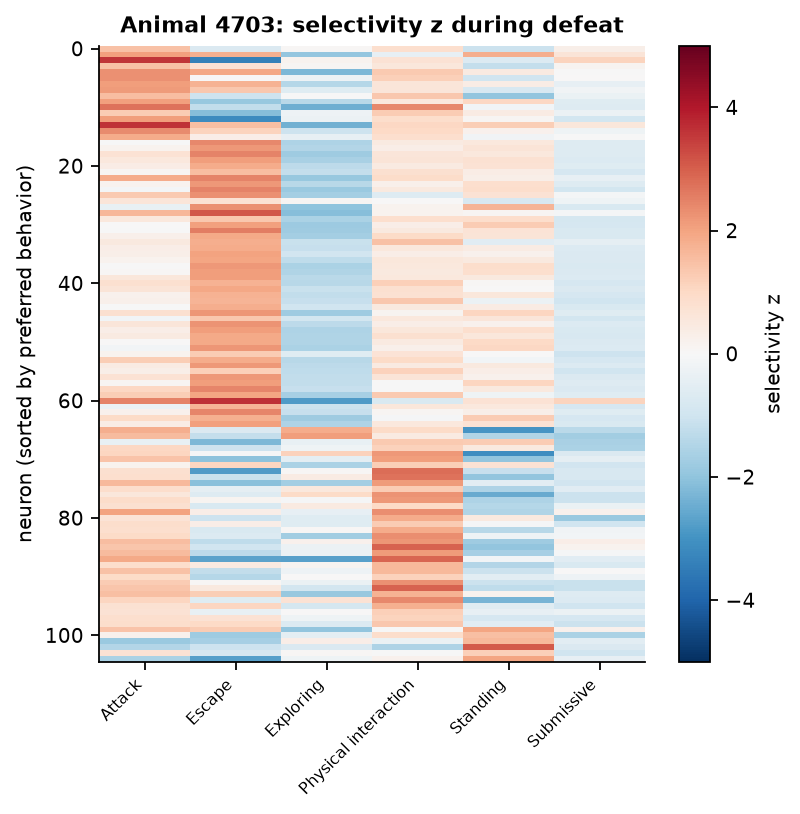
Selectivity statistic. For neuron i and behavior b: Δ = mean spike probability during b − mean outside b.
Null model. The behavior mask was circularly shifted 500 times by 5–95% of the recording length, keeping bout lengths and number intact, and Δ was recomputed for each shift. A neuron is excited if Δ ≥ the null at p < 0.01 (one-sided), and inhibited if Δ ≤ the null at p < 0.01. Selectivity z = (Δ − null mean)/null SD. Behaviors needed ≥ 60 frames (≈ 9 s) per animal.
Fractions. The expected false-positive fraction is 1% per direction. For each behavior, the per-animal fraction of excited neurons was tested against 0.01 (one-sample exact Wilcoxon, one-sided), with FDR across behaviors.
Reactivation. Defeat ensemble = neurons excited by physical interaction in SD. Social ensemble = neurons excited by Interaction/Approach during the SIT CD-1 phase. A hypergeometric test treats neurons as exchangeable, but neurons with high rate or variance reach significance more easily in any context, which inflates overlap. The primary null therefore keeps neuron identity: the SIT label sequence was circularly shifted (10–90% of its length, 100 shifts), the SIT social ensemble re-derived with the same selectivity test, and its overlap with the (unchanged) defeat ensemble recorded. Per-animal p = (1 + #null ≥ observed)/101. Per-animal p-values were combined with Fisher's method, and overlap − null mean was tested across animals with a one-sided exact Wilcoxon. The hypergeometric p is reported as a secondary value. The same analysis was run for neurons excited by non-physical interaction in BL + SS (the non-physical ensemble).
Parameters
| Parameter | Value |
|---|---|
n_shifts | 500 |
alpha | 0.01 |
min_frames | 60 |
overlap_null_shifts | 100 |
Highlights
trend
Standing-excited neurons
6.6%
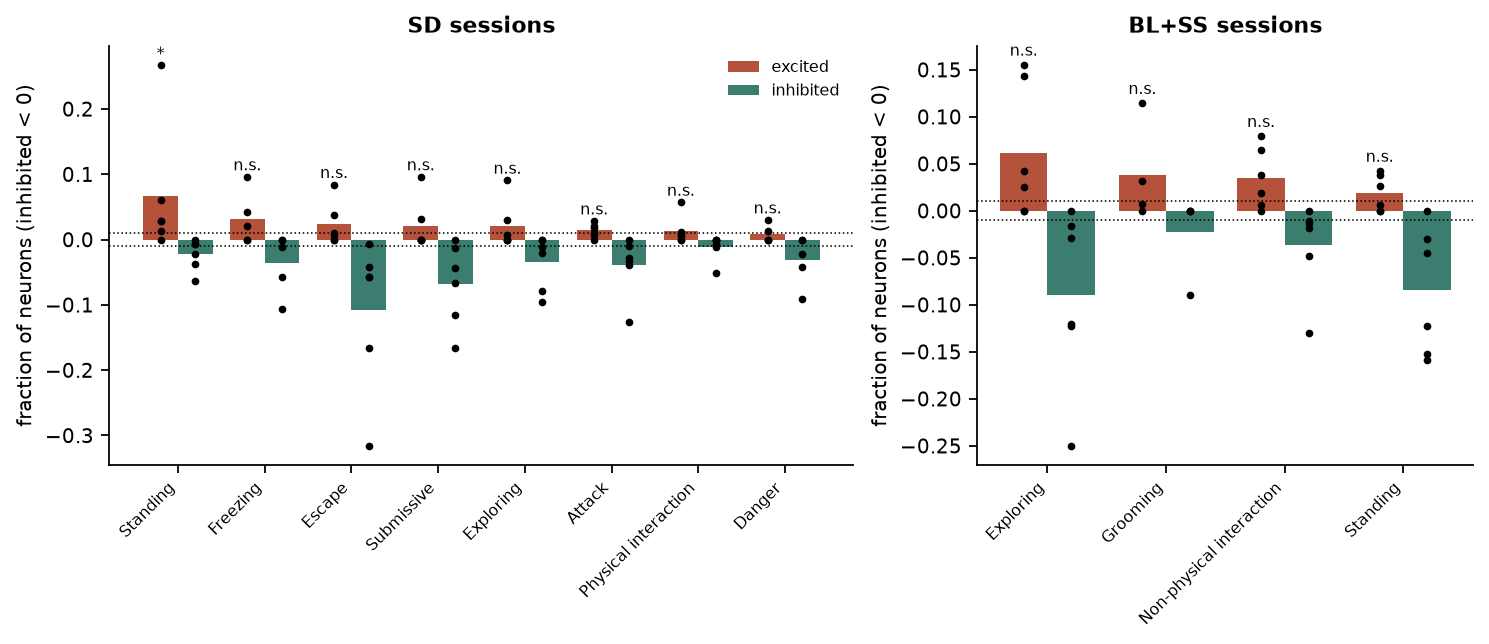
Mean fraction per animal during defeat (chance 1%), p = 0.047, q = 0.474.
null
Freezing-excited neurons
3.2%
Mean fraction per animal during defeat (chance 1%), p = 0.156, q = 0.474.
caution
Defeat → SIT reactivation
×0.00 vs null
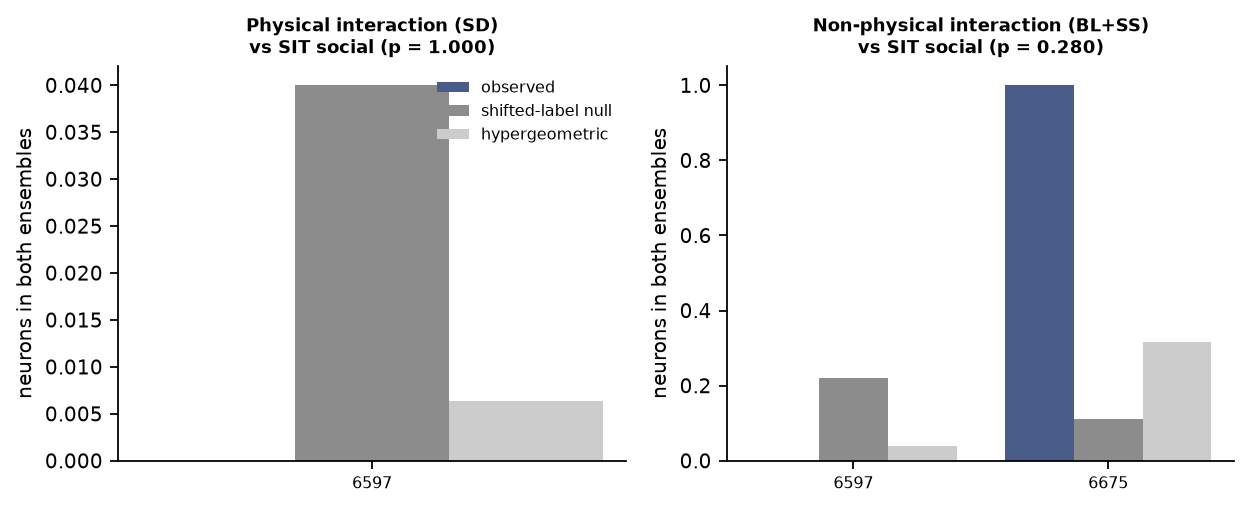
Overlap between defeat-excited and SIT-social neurons relative to shifted-label SIT ensembles (1 informative animal; Fisher-combined p = 1.000; Wilcoxon n/a).
caution
Non-physical → SIT reactivation
×3.03 vs null
Overlap between neurons excited by non-physical interaction (BL+SS) and SIT-social neurons (Fisher-combined p = 0.280; Wilcoxon n/a; 0/2 animals individually p < 0.05).
Results
Behavior tuning during defeat. The largest fractions of selectively excited neurons in SD sessions were standing (6.6%), freezing (3.2%), escape (2.3%), against a 1% false-positive expectation (Table 1, Figure 1). 0 of 13 behavior × context combinations showed above-chance excited fractions after FDR correction, and 0 showed above-chance inhibited fractions.
Reactivation in the SIT. Only 2 of 5 animals with a SIT recording had any SIT-social neuron at p < 0.01, and 1 (defeat) and 2 (non-physical) animals had non-empty ensembles in both contexts. Reactivation therefore cannot be tested in this cohort, and the values below are descriptive. Across 1 informative animal, 0 neuron(s) were in both the defeat (physical interaction) ensemble and the SIT social ensemble, against 0.0 under the shifted-label null and 0.0 under exchangeable neurons (Fisher-combined shift p = 1.000; hypergeometric p = 1.000; Wilcoxon of overlap − null n/a). For the non-physical ensemble, 1 neuron(s) overlapped against 0.3 under the shifted-label null (Fisher-combined p = 0.280; hypergeometric p = 0.641; Wilcoxon n/a; Table 2, Figure 3). Fisher's method is sensitive to a single strongly overlapping animal, so a combined effect counts as robust only when the across-animal Wilcoxon agrees.
Figures
Tables
Table 1. Fraction of behavior-tuned neurons
| context | behavior | n_animals | excited_mean | inhibited_mean | p_excited | p_inhibited | q_excited | q_inhibited |
|---|---|---|---|---|---|---|---|---|
| BL+SS | Exploring | 6 | 0.0611 | 0.0896 | 0.0781 | 0.0469 | 0.474 | 0.152 |
| BL+SS | Grooming | 4 | 0.0383 | 0.0224 | 0.312 | 0.688 | 0.58 | 0.745 |
| BL+SS | Non-physical interaction | 6 | 0.0345 | 0.0365 | 0.109 | 0.109 | 0.474 | 0.203 |
| BL+SS | Standing | 6 | 0.0189 | 0.0848 | 0.219 | 0.0312 | 0.474 | 0.152 |
| SD | Standing | 6 | 0.0663 | 0.0228 | 0.0469 | 0.219 | 0.474 | 0.284 |
| SD | Freezing | 5 | 0.0319 | 0.0353 | 0.156 | 0.312 | 0.474 | 0.369 |
| SD | Escape | 6 | 0.0233 | 0.107 | 0.422 | 0.0312 | 0.65 | 0.152 |
| SD | Submissive | 6 | 0.0214 | 0.0673 | 0.5 | 0.0469 | 0.65 | 0.152 |
| SD | Exploring | 6 | 0.0212 | 0.0342 | 0.5 | 0.156 | 0.65 | 0.226 |
| SD | Attack | 6 | 0.0142 | 0.0392 | 0.219 | 0.0781 | 0.474 | 0.169 |
| SD | Physical interaction | 6 | 0.0135 | 0.0115 | 0.781 | 0.781 | 0.781 | 0.781 |
| SD | Danger | 5 | 0.00859 | 0.0309 | 0.688 | 0.156 | 0.745 | 0.226 |
| SIT_CD1 | Social engagement | 4 | 0.0088 | 0.118 | 0.688 | 0.0625 | 0.745 | 0.163 |
Table 2. Defeat and non-physical ensembles vs SIT social ensemble
| subject | source | n_neurons | source_ensemble | SIT_social_ensemble | overlap | expected | null_overlap_mean | p_shift | p_hypergeom | ratio_obs_exp | ratio_obs_null |
|---|---|---|---|---|---|---|---|---|---|---|---|
| 4703 | Physical interaction (SD) | 105 | 6 | 0 | 0 | 0 | |||||
| 4703 | Non-physical interaction (BL+SS) | 105 | 2 | 0 | 0 | 0 | |||||
| 6445 | Physical interaction (SD) | 95 | 0 | 0 | 0 | 0 | |||||
| 6445 | Non-physical interaction (BL+SS) | 95 | 0 | 0 | 0 | 0 | |||||
| 6597 | Physical interaction (SD) | 156 | 1 | 1 | 0 | 0.00641 | 0.04 | 1 | 1 | 0 | 0 |
| 6597 | Non-physical interaction (BL+SS) | 156 | 6 | 1 | 0 | 0.0385 | 0.22 | 1 | 1 | 0 | 0 |
| 6669 | Physical interaction (SD) | 187 | 1 | 0 | 0 | 0 | |||||
| 6669 | Non-physical interaction (BL+SS) | 187 | 12 | 0 | 0 | 0 | |||||
| 6672 | Physical interaction (SD) | 166 | 2 | 0 | 0 | 0 | |||||
| 6672 | Non-physical interaction (BL+SS) | 166 | 1 | 0 | 0 | 0 | |||||
| 6675 | Physical interaction (SD) | 139 | 0 | 4 | 0 | 0 | 0 | ||||
| 6675 | Non-physical interaction (BL+SS) | 139 | 11 | 4 | 1 | 0.317 | 0.11 | 0.0792 | 0.284 | 3.16 | 9.09 |
Table 3. Tuned fractions per animal
| context | behavior | subject | excited | inhibited | neurons |
|---|---|---|---|---|---|
| BL+SS | Digging | 4703 | 0.0571 | 0.0286 | 105 |
| BL+SS | Digging | 6445 | 0 | 0.0421 | 95 |
| BL+SS | Digging | 6597 | 0.0577 | 0.00641 | 156 |
| BL+SS | Exploring | 4703 | 0 | 0.0286 | 105 |
| BL+SS | Exploring | 6445 | 0 | 0 | 95 |
| BL+SS | Exploring | 6597 | 0.0256 | 0.25 | 156 |
| BL+SS | Exploring | 6669 | 0.155 | 0.016 | 187 |
| BL+SS | Exploring | 6672 | 0.0422 | 0.12 | 166 |
| BL+SS | Exploring | 6675 | 0.144 | 0.122 | 139 |
| BL+SS | Grooming | 4703 | 0.114 | 0 | 105 |
| BL+SS | Grooming | 6445 | 0.0316 | 0 | 95 |
| BL+SS | Grooming | 6597 | 0 | 0.0897 | 156 |
| BL+SS | Grooming | 6675 | 0.00719 | 0 | 139 |
| BL+SS | Non-physical interaction | 4703 | 0.019 | 0 | 105 |
| BL+SS | Non-physical interaction | 6445 | 0 | 0.0105 | 95 |
| BL+SS | Non-physical interaction | 6597 | 0.0385 | 0.0128 | 156 |
| BL+SS | Non-physical interaction | 6669 | 0.0642 | 0.0481 | 187 |
| BL+SS | Non-physical interaction | 6672 | 0.00602 | 0.0181 | 166 |
| BL+SS | Non-physical interaction | 6675 | 0.0791 | 0.129 | 139 |
| BL+SS | Standing | 4703 | 0.0381 | 0.152 | 105 |
Limitations
- Behaviors co-occur in time (e.g. submissive postures follow attacks). Selectivity is marginal, not conditional on other behaviors. A multivariate encoding model (GLM) is the natural extension.
- SIT phases are short (~150 s), which limits power to detect SIT-tuned neurons. Mouse 6669 has no SIT imaging block. In this cohort only a minority of animals yield a non-empty SIT-social ensemble at the chosen threshold, so reactivation overlap is underpowered and is reported as descriptive.
- Neuron identity across sessions relies on the manually drawn ROIs being applied to the whole longitudinal movie.
References
- Diminished social memory and hippocampal correlates of social interactions in chronic social defeat stress susceptibility (2025) Biol Psychiatry Glob Open Sci. https://www.bpsgos.org/article/S2667-1743(25)00009-6/fulltext
- Li L. et al. (2023) Social trauma engages lateral septum circuitry to occlude social reward. Nature 613:696–703.
- Hultman R. et al. (2016) Dysregulation of prefrontal cortex-mediated slow-evolving limbic dynamics drives stress-induced emotional pathology. Neuron 91:439–452.
- Gründemann J. et al. (2019) Amygdala ensembles encode behavioral states. Science 364:eaav8736.